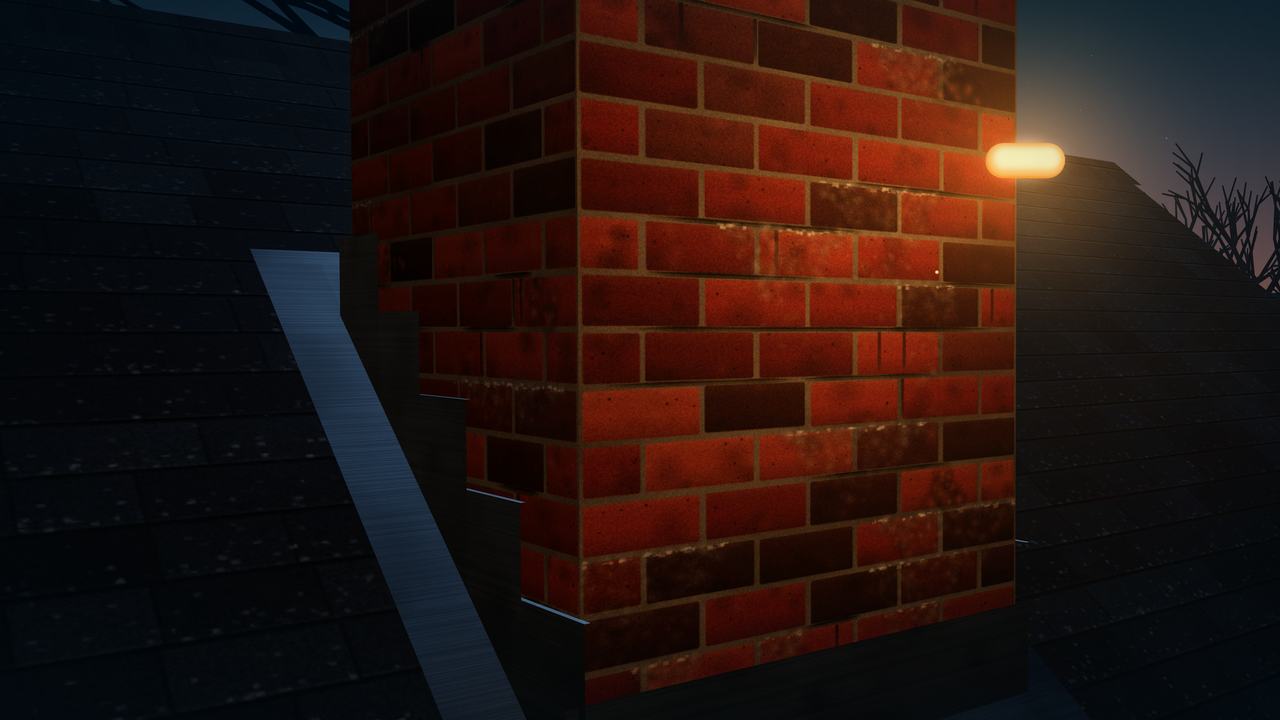
How to check a chimney without leaving the ground
You do not need a ladder to notice most of what follows, and you should not use one. Stand back in the yard with binoculars and look at each side of the chimney. The Brick Industry Association (BIA) says exterior surveys of brick masonry should be done with binoculars, and HUD’s Residential Rehabilitation Inspection Guide says the same about a chimney that is hard to reach. Then look indoors: the ceiling and walls around the chimney, and the firebox with a flashlight.
BIA recommends a look each season. Almost every sign below comes back to water. The Chimney Safety Institute of America (CSIA) has said that all masonry chimney materials except stone deteriorate faster with prolonged contact with water.
One limit: a sign tells you where to look, not what is wrong. Naming the cause takes someone who can see the top of the chimney and the inside of the flue.
The signs at a glance
| Sign | Where you see it | What it can mean |
|---|---|---|
| White, powdery staining | Brick faces | Water is moving through the masonry |
| Crumbling or missing mortar | Joints between bricks | Joints that let water in |
| Flaking brick faces | Brick, and chips on the ground | Water in the brick that has frozen |
| Rust | Damper, firebox, cap, stains on the chimney | Water inside the chimney, or a rusting cap |
| Water stains | Ceiling and walls near the chimney | Water getting past the roof line or the top |
| Cracked crown, bent or missing cap | Top of the chimney | An open path for rain and snow |
| Damp, smoky odor | Fireplace | Moisture meeting creosote |
White staining on the brick
The white, chalky film has a name: efflorescence. BIA describes it as white deposits left on the brick surface when moisture carrying dissolved salts evaporates. BIA also says it is usually not harmful to brick masonry.
So the stain is not the problem. It is evidence that water has been traveling through the brick. BIA’s advice is to find and fix the water source before cleaning, because otherwise the efflorescence will return. An archived CSIA blog post adds that rain can cause efflorescence, but on chimneys it is often moisture from flue gases. Cleaning the stain off before the water source is found only buys time, because it comes back.
Crumbling or missing mortar
Look at the lines between the bricks. CSIA has described proper mortar joints as having no gaps or missing mortar.
In CSIA’s words, deteriorated joints are “entry spots for water”. BIA lists the conditions that call for repair: mortar eroded deeper than 1/4 inch, crumbling mortar, mortar with voids, hairline cracks in the mortar, and cracks between the brick and the mortar.
The repair is called repointing, and BIA notes that it is sometimes called tuckpointing. Damaged mortar is removed to a uniform depth and new mortar is placed in the joint. BIA says it should be done only by qualified, experienced craftspeople. Our chimney tuckpointing page covers brick and mortar repair, whose price is on request.
Flaking or spalling brick
Spalling is the term for brick whose face has flaked or popped off. Look for flaked faces on the stack and for pieces of brick on the ground below.
An archived CSIA blog post gives the cause: the brick absorbs water, and “when the water freezes it pops the faces of the brick off”. The National Weather Service describes winters here as “changeable”, with “frequent thaws and rain as well”, so wet masonry can freeze, thaw and freeze again.
BIA says that when brick is broken or heavily spalled and letting moisture in, replacing the damaged units may be necessary. How many is something chimney repair sorts out up close.
Rust
Indoors, look at the damper and the firebox. CSIA has said that water in the chimney rusts steel and cast iron, and its list of water damage includes rusted damper assemblies. Rust there is a reason to ask where water is getting in.
Outdoors, look for rust stains on the chimney. The CSIA blog post says common galvanized caps rust within years and can stain the chimney, and HUD’s guide treats rust stains on a mortar chimney top as a reason to replace that top. Have the cap and the crown checked.
Water stains inside the house
Water stains on a ceiling or wall near the chimney deserve attention. CSIA’s list of water damage includes water stained walls and ceilings and ruined wall coverings.
One common culprit is the flashing, the seal where the chimney meets the roof. The CSIA blog post says many leaks are flashing related. CSIA has said flashing keeps rain and snow melt from running down the chimney into living spaces, “where it can damage ceilings and walls and cause rot in rafters”.
But a stain shows where water ended up, not where it got in. The CSIA blog post points out that overflowing gutters, and downspouts that discharge near the chimney, can make water appear in places that look chimney related.
Our Level 2 chimney inspection costs $99. It is a visual assessment plus an internal camera examination where accessible, and an evaluation for visible signs of water intrusion, leaks and masonry deterioration. It is not a comprehensive leak test and does not guarantee that a leak will be found. See chimney leak repair for how leak repairs are quoted.
A cracked crown or a damaged cap
The crown is the slab that seals the top of the masonry around the flue. The cap is the cover over the flue opening. Our guide to the cap, crown and flashing tells them apart.
From the ground you see only the edge of the crown, so look for pieces missing from that edge and for deterioration of the masonry near the top. HUD’s guide explains why: a deteriorated top lets water into the masonry below and exposes it to freeze-thaw cycles. HUD says concrete or stone tops with minor, shallow cracking should be repaired, and a mortar top that is extensively cracked or spalled should be replaced. Which case you have is a judgment made up close. See chimney crown repair.
For the cap, check that it is there and that it is not rusted. CSIA has noted that an uncovered flue can collect rainwater and funnel it into the chimney.
Odors from the fireplace
A damp, sooty smell from a wood-burning fireplace is a sign too. CSIA has said that when water mixes with creosote in a chimney, it produces “a highly disagreeable odor that can permeate a home”.
An odor raises two questions: is water getting in, and how much buildup is in the flue? A chimney sweep and cleaning costs $199 and removes soot and creosote buildup. It does not fix a leak.
A gas smell is a different matter. If you smell gas, leave the house and call the gas utility or 911.
When to stop using the fireplace and call
CSIA says a chimney deteriorated by constant exposure to the weather can be a potential safety hazard. Some signs are serious enough that you should stop burning until the chimney has been looked at.
- The chimney leans or has shifted. HUD’s guide says unstable chimneys, or those with a noticeable lean, should be dismantled and rebuilt.
- Wide or stepped cracks. BIA lists cracks wider than 0.075 inch (2 mm), cracks through several bricks, stepped or diagonal cracks and widespread spalled brick as conditions that can be structural and call for a professional engineer.
- Broken flue tile. CSIA lists cracked or collapsed flue tiles, or tiles with large chunks missing, among the signs of a chimney fire. After a fire, it says, cracked tiles and displaced mortar can give flames a path to the wood frame of the house.
- Traces of a past chimney fire. CSIA’s list includes smoke escaping through mortar joints, a discolored or distorted cap, warped damper metal, creosote flakes on the roof or ground, and cracks in the exterior masonry. CSIA says the majority of chimney fires go undetected, and advises not using the chimney after one until it has been swept and evaluated by a qualified chimney professional.
Three situations are emergencies, not appointments.
- Signs of a chimney fire. CSIA describes loud cracking and popping, a lot of dense smoke, an intense hot smell and a low rumbling sound. Get out and call 911.
- A carbon monoxide alarm. Get to fresh air and call 911.
- A gas smell. Leave the house and call the gas utility or 911.
What to do with what you found
Pick the visit that fits what you saw.
- You can see damage. Ask about chimney repair. The price of a repair is on request, and we explain what we see and what it will cost before work starts.
- You see a sign but not a cause. Start with a chimney inspection. The Level 1 inspection costs $69. It is a basic visual inspection of the readily accessible chimney and fireplace components, checking for visible damage, deterioration and safety concerns. No internal camera inspection is included. The Level 2 inspection, described above, costs $99.
- You need an inspection for a home sale, a new appliance or after a fire. Tell us when you book so the scope can be confirmed.
Whatever you found, crown to hearth, we explain what we see and what it will cost before work starts, and we recommend the smallest repair that solves the problem. Repairs are planned with Western New York freeze and thaw cycles in mind. New customers get 15% off: tick the new customer box in the form, or say so when we call.
Book a visit once you know which one you need. After a request, the team calls back as soon as possible to confirm the appointment.