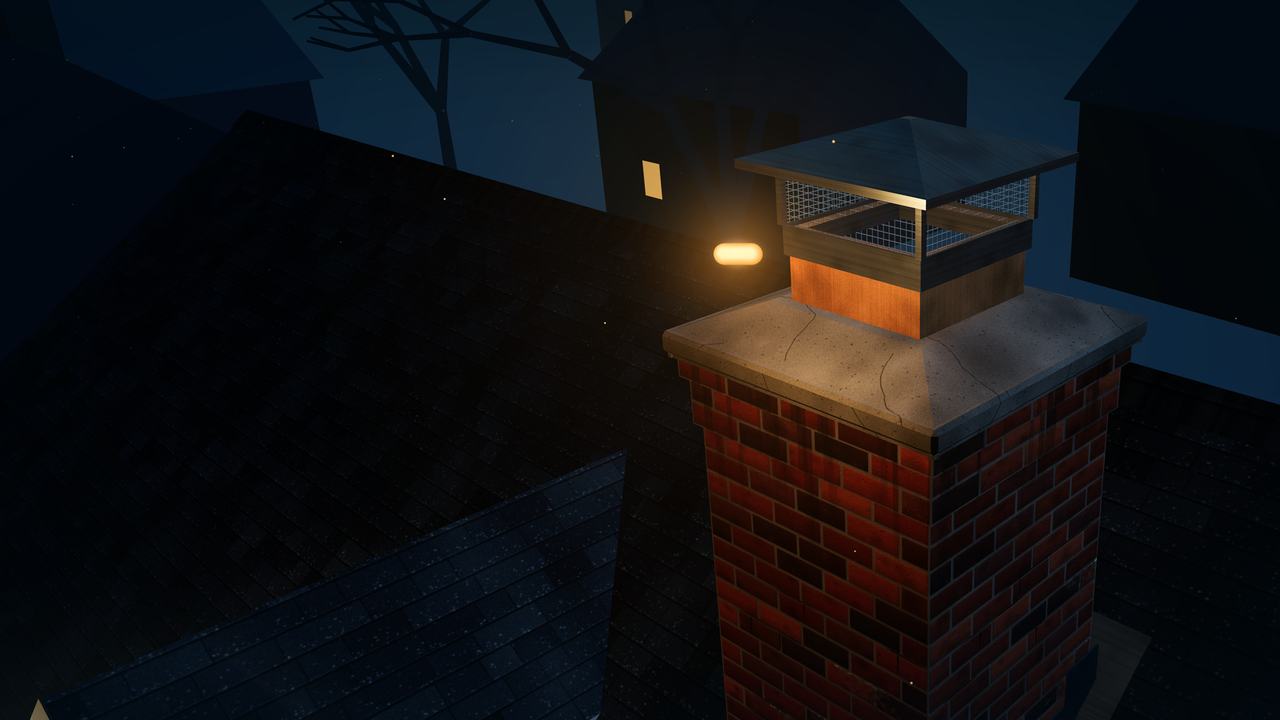
Why the chimney takes the weather first
A chimney stands above the roof with nothing around it. The U.S. Department of Housing and Urban Development (HUD) says in its Residential Rehabilitation Inspection Guide that chimneys “have greater exposure to the weather than most building elements”. The Brick Industry Association (BIA) lists chimneys among the masonry that sees more severe exposure and may need repairs at shorter intervals than an ordinary brick wall.
Here that exposure means rain, snow, meltwater and a long season of freezing nights.
How water gets into a masonry chimney
A masonry chimney has four defenses against water. The brick is not one of them. The Chimney Safety Institute of America (CSIA) has described common brick as “like a sponge, absorbing water and wicking moisture to the chimney interior”.
| Part | Its job | How it fails |
|---|---|---|
| Cap | Covers the flue opening | Missing or rusted |
| Crown | Seals the top of the masonry around the flue | Cracks, chips, crumbles |
| Mortar joints | Hold the brick and shed water | Erode, crack, leave gaps |
| Flashing | Seals the roof to the chimney | Rusts, or was only glued or tarred on |
The cap. CSIA has said the large openings (flues) at the top of a chimney “can collect rainwater and funnel it directly to the chimney interior”, and that a commonly sized flue can take in large amounts of rain or snow in a single winter. See chimney caps.
The crown. The crown is the top element of the chimney. CSIA says it covers and seals the top from the flue liner to the chimney edge. CSIA has said most masonry chimneys were built with a crown of common mortar mix that “will crack, chip, or deteriorate from weather exposure”. For new work, the 2025 Residential Code of New York State requires a concrete, metal or stone top that is sloped to shed water and has a drip edge. The code’s heading for this requirement is “chimney caps”, so expect the two words to be used loosely. See chimney crown repair.
The mortar joints. CSIA has called deteriorated joints “entry spots for water” and noted that weathered mortar “becomes much more absorbent”. Our chimney tuckpointing page covers brick and mortar repair.
The flashing. Flashing is the seal between the roofing and the chimney. In CSIA’s words, it keeps “rainwater or snow melt” from running down the chimney into living spaces. An archived CSIA article says many leaks are flashing related.
The same article notes that damaged or overflowing gutters, and downspouts that empty near or on the chimney, can make water appear in places that look chimney related.
What freezing does to wet masonry
Water alone wears masonry down. CSIA has said all masonry chimney materials except stone “suffer accelerated deterioration” from prolonged contact with water. Freezing speeds that up. In CSIA’s description, masonry deteriorates quickly in the freeze and thaw process, “in which moisture that has penetrated the materials periodically freezes and expands causing undue stress”.
Three kinds of damage follow.
- Flaking brick. The trade word is spalling. An archived CSIA article explains that brick soaks up moisture, and “when the water freezes it pops the faces of the brick off”.
- Failing mortar. HUD’s guide, describing parapet walls, which it says chimneys resemble in their exposure to weather, says water penetration followed by freeze-thaw cycles causes “masonry spalling and mortar deterioration”.
- Damage that starts at the top. HUD lists deterioration of the masonry near the top when a failed top “allows water into the masonry below and exposes it to freeze-thaw cycles”.
The process feeds itself. Weathered mortar becomes much more absorbent, so a joint that has started to fail can take in more water before the next freeze.
Why Western New York winters make it worse
Freeze and thaw damage needs water in the masonry and temperatures that cross the freezing point. Western New York supplies both.
- Thaws are part of winter. The National Weather Service describes winters in Western New York as generally cloudy, cold and snowy, but “changeable”, with “frequent thaws and rain as well”.
- Freezing nights are many. NOAA’s 1991 to 2020 climate normals give Buffalo 123.7 days a year with a low at or below 32 F. On 48.6 days the high also stays at or below 32 F. Subtract one from the other and about 75 days a year remain when the temperature is at or below freezing at some point and above it at another. That figure is our subtraction, not an official count of freeze and thaw cycles.
- Snow adds to the rain. Normal snowfall in Buffalo is 95.4 inches a year, by the 1991 to 2020 normals. The National Weather Service says over half of the annual snowfall is lake-effect snow, and that areas south of Buffalo receive much more of it than areas to the north.
- The housing is old. The Census Bureau’s 2020 to 2024 American Community Survey estimates that 61.0 percent of housing units in the City of Buffalo were built in 1939 or earlier.
The 1991 to 2020 normals for Rochester are close: 128.8 days a year with a low at or below 32 F, and 102.0 inches of snow.
Why the damage shows up in spring
Two things line up at the end of winter.
- The freezing outlasts the snow. The median date of the last 32 F freeze in Buffalo is April 24, by NOAA’s 1991 to 2020 normals, and a normal March still brings 14.1 inches of snow. The National Weather Service puts it in one line: “Spring comes slowly to the Buffalo area.”
- Rain takes over. A CSIA article says spring rains “can reveal leaks and other problems that may have been hidden in previous months”.
By spring the chimney has been through the freezing season, so spring is a good time to look. Look from the ground. BIA says exterior surveys of brick masonry should be performed with binoculars for a close-range view. Do not go on the roof. Work down the chimney, crown to hearth:
- Pieces missing from the edge of the crown, or a cap that is gone or rusted.
- Flaked brick faces on the stack, and chips of brick on the roof or the ground.
- Mortar joints that are crumbling, cracked or worn back from the face of the brick.
- White deposits on the brick, which BIA describes as what is left when moisture carrying dissolved salts evaporates.
- Indoors, the items on CSIA’s list of water damage: water-stained walls and ceiling, and rusted damper assemblies.
Our guide to the signs your chimney needs repair goes through each one.
How to limit freeze and thaw damage
The mechanism points to the remedy. Keep water out of the masonry, and close small openings while they are small.
- Cover the flue. CSIA has called a chimney cap probably the most inexpensive preventive measure a homeowner can use against water penetration.
- Keep the crown sound. HUD’s guide separates two cases. A concrete or stone top with minor, shallow spalling and cracking should be repaired. A mortar top that is not properly sloped, or is extensively cracked or spalled, should be replaced.
- Repoint worn joints with the right mortar. BIA’s list of conditions that call for repointing includes mortar eroded deeper than 1/4 inch, crumbling mortar, voids and hairline cracks. BIA also warns that new mortar stronger than the original “can lead to spalling of the brick face”. Harder is not better.
- Have the flashing and the gutters looked at. Both can send water to the same stain.
- Do not paint the brick or coat it with a clear sealer. CSIA has said these should never be used for waterproofing, because they trap water vapor and moisture inside the chimney. BIA says coatings should be considered only after repairs are complete, and that only water repellents that let water vapor pass should be used on exterior brickwork.
- Look every season and inspect every year. BIA recommends periodic inspections of brick masonry, preferably each season. CSIA quotes NFPA 211 as saying chimneys, fireplaces and vents shall be inspected at least once a year.
A CSIA article says most sweeps consider summer the season for repair work such as masonry repairs. The median first fall freeze in Buffalo is October 26, by the same NOAA normals. A problem found in April leaves the warm months to fix it.
Fixing a cap, a crown, mortar joints or flashing is roof work or masonry work. It is a job for a professional. BIA says repointing should be done only by qualified, experienced craftspeople.
What to do if you see signs now
If you can see damage, start with chimney repair. The price of chimney leak repair, crown repair, chimney caps, and brick and mortar repair is on request, and we explain what we see and what it will cost before work starts.
If you see a sign but not a cause, start with a chimney inspection. The Level 1 inspection costs $69 and includes no internal camera inspection. The Level 2 inspection costs $99. It is a visual assessment plus an internal camera examination where accessible, and an evaluation for visible signs of water intrusion, leaks and masonry deterioration. It is not a comprehensive leak test and does not guarantee that a leak will be found.
ChimneY Royal has 15 years of chimney experience, and repairs are planned with Western New York freeze and thaw cycles in mind. We explain what we see and what it will cost before work starts. We recommend the smallest repair that solves the problem. New customers get 15% off: tick the new customer box in the form, or say so when we call.
When you are ready, book a visit. After a request, the team calls back as soon as possible to confirm the appointment.
Water damage is a repair question. These three are emergencies:
- A gas smell. Leave the house and call the gas utility or 911.
- A carbon monoxide alarm. Get to fresh air and call 911.
- Signs of a chimney fire. Get out and call 911.